


On/Off-Discrepancies in Medical Decision-Making: Utilising the Reversibility of Deep Brain Stimulation to Strengthen Patient Autonomy
New publication
09. Januar 2026
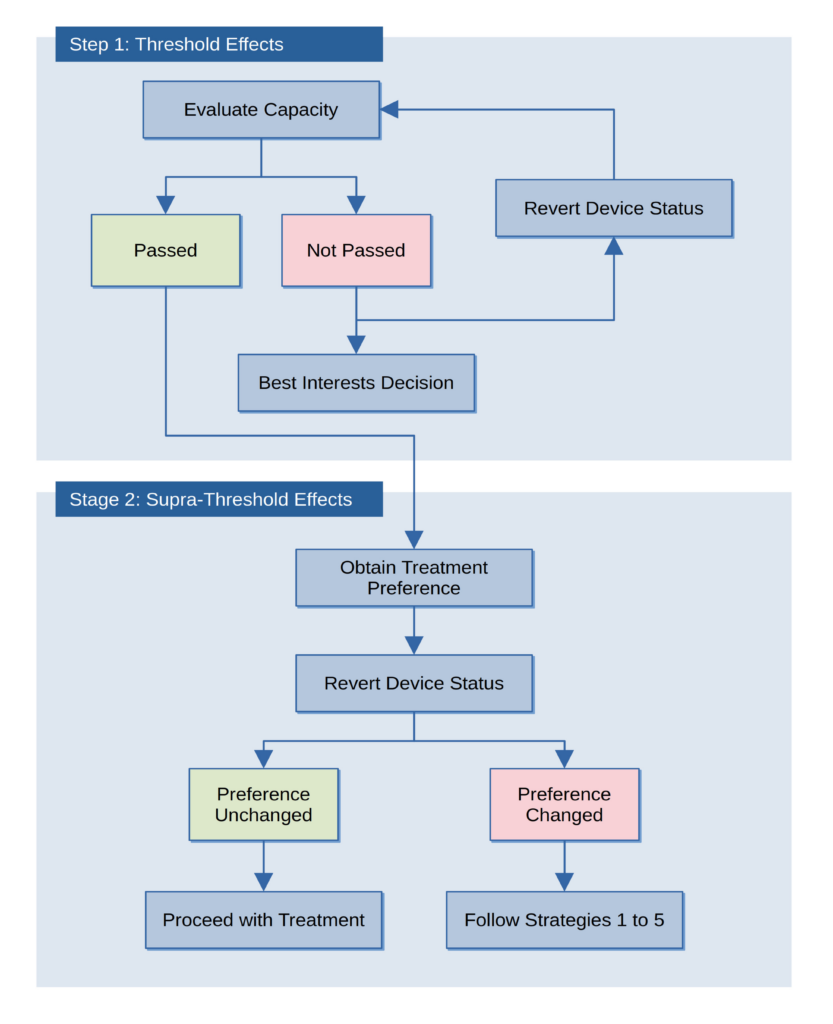
Some medical interventions have the potential to interfere with patients’ future healthcare decision-making. The article identifies two types of such influences: affecting whether a patient has decision-making capacity in the first place; and influencing which treatment option a patient ends up selecting.
Using the example of deep brain stimulation, the authors argue that one should utilise this effect to obtain more authentic treatment preferences. In patients with implanted deep brain stimulators who do not meet the capacity threshold, the device state should be reverted as there is a chance that doing so has a positive effect on their capacity. In patients who are already deemed decision-competent, the same approach can reveal on/off-discrepancies in the selection of treatment choices.
The paper – which won the Young Talent Award of the German Academy for Ethics in Medicine (AEM) [Link: https://aem-online.de/nachwuchspreistraeger-2025/] – proposes five cross-checking strategies to deal with such discrepancies and calls for a revision of current procedures for obtaining consent following any interventions whose psychotropic influences can be reversed within clinically reasonable time frames.
Link to paper: https://doi.org/10.1007/s00481-025-00893-2
Authors:
Lukas J. Meier (Harvard / TUM) – https://lukasjmeier.com Aaron D’Sa (Cambridge) – https://www.fitz.cam.ac.uk/person/dr-aaron-dsa
Kontakt
Das Institut für Geschichte und Ethik der Medizin freut sich über Ihre Kontaktaufnahme.
81675 München

 DE
DE  EN
EN